On Monday and Tuesday mornings, I teach Plus-1 students at JM’s upper campus—called so because it sits on top of a hill in central Tirur; whereas, the “lower campus” sits at the bottom of the hill.
The Indian school system only goes from 1st to 10th standards. (Tenth standard students being equivalent in age to American high school freshmen.) After 10th standard, Indian students have an option to matriculate to the “Plus” standards—Plus-1 and Plus-2—which are equivalent to American high school sophomores and juniors. After the “Plus” standards, they can then move on to university. Typically, students who are in a “Plus” standard have plans to go to higher education.
On this Tuesday, I entered the upper campus and climbed four flights of stone steps to the teachers’ lounge on the third floor. There, I found six Plus-1 students—all boys—standing in a line outside the lounge door looking stone-faced and rather sheepish. My teacher instincts told me they were in some kind of trouble.
I walked into the lounge and found Vinod sitting at the long table that takes up most of the space in this narrow, crowded room. Vinod teaches Computer Science and has the best English of any teacher I have met at JM.
“Trouble?” I ask, pointing beyond my shoulder at the students, who could be seen through the lounge’s glass windows.
“Punishment,” Vinod said. “Latecomers.”
“What is there punishment?” I asked.
Vinod gave a quick nod of his head. I turned around. At that moment, another teacher walked up to the boys from the other end of the hall. He had a thin bamboo switch in his hand. He curtly inclined is head to the boys, and they all dutifully stretched out their right arms (as if they knew what was coming). The teacher then whapped each boy three times on the wrist. Fwip! Fwip! Fwip!
The boys flinched in pain and then withdrew their arms, rubbing their wrists. A couple of the boys smiled with false bravado. (I knew the look well from teaching at Hogg.)
“Happen often?” I asked Vinod.
“Sometimes,” he said, engrossed in going over his lesson for the day. Vinod is slight and light-skinned with a rakish flop of wavy hair parted to the side that makes him look oddly like an aristocrat from Stuart England.
“What do kids get punished for?” the boys outside were still rubbing their wrists but now quietly commiserating with each other about their collective fate, chuckling and playfully punching each other on the shoulders.
“Being late. Not turning in assignments. Being disrespectful. Causing a distraction,” Vinod said, then he squinted his eyes thoughtfully.
“You know,” he said. “It is necessary.”
My raised eyebrows must have given Vinod the impression that I wanted more of an explanation, which I did.
“Necessary because a lot of these kids—most of these kids here in the Plus-1 and Plus-2 standards—have come to us from government schools,” he said. “They did not have the structure at the government schools that they have here. We have rules and regulations that they are not used to.”
“For instance?”
“Well, at the government schools, for example, kids can just get up whenever they want and leave the class,” Vinod said with a resigned waggle of his head. “It is unfortunate because a lot of times teachers do not even show up to these government schools.”
I had heard that complaint before—in the newspaper, from my ATI supervisors, on Indian TV, in books. Teachers at Indian government schools had a notorious reputation for profligacy and apathy. Though, I had to take all this evidence at face value. The only schools I had ever taught in India (both in Kolkata and in Tirur) were private schools.
“Why do these students come here? To JM?” I asked.
“A law was passed just recently, that limits class size in Plus-1 standards to 60 students per class. The government schools in Tirur are all filled up,” Vinod explained.
“SIXTY students in a class?” I asked, clearly alarmed.
Vinod smiled slightly. “Sixty students. And every government school classroom in Tirur is full.”
“So these are the students who were leftover?”
“Some. Well, most: yes. Others made the choice to come here. Maybe their families did not like the government school and thought they would get a better education here. Others have been at JM since 1st standard.”
I could not help but ask my next question, owing to a rough class period I had had the previous day. “Is that why these students are…a little more…wild?”
Vinod smiled again. “They are a challenge. Their English is not as good and, like I said, they are not used to our rules here. So, yes, it is harder to teach them”
I thought it propitious how my discussion with Vinod had dovetailed neatly with an email I received the othe day from my mother, who still teaches in public schools in America though she is semi-retired. The email contained a link to an article from The New York Times Review of Books critical of the recently released documentary Waiting for Superman. The film—though I have not seen it—levies much criticism at American public education while promoting charter schools as a viable alternative.
I cannot comment on the film, but it is interesting to note India’s gargantuan education bureaucracy is also dealing with matters of “school choice” and accountability. Maybe just on a much, much bigger scale.
The bell rang, and I readied my materials to go meet my class of nearly 50 students.
Tuesday, November 23, 2010

Monday, November 22, 2010
Bullseye (sort of)
I noticed one of my students coming down the hill with a banana leaf in his hand. The leaves are commonly used in Kerala as plates, even at restaurants, so I figured he had picked up some breakfast on the way to school.
It was a little past nine in the morning—before the opening bell—and the day’s humidity was already palpable. I was making my way to JM’s “upper campus” where I teach on Mondays and Tuesdays. The student I saw is one I teach at the “lower campus” later in the week.
I slowed down as we neared each other and he opened the leaf, cupped as it was in his hand. What peered back at me from the leaf were two translucent balls vaguely familiar in their form and shape. The student was quietly laughing. And I realized that what was on the banana leaf literally was peering at me. The student was carrying two eyes, as big as golf balls, shiny and slick looking with a luminescent indigo hue.
“Eyes!?” I asked hoarsely.
The student nodded, then made a motion as if to eat one. He laughed more loudly as he walked away and I confusedly continuted on to school.
After my first two periods, I found myself with some free time in the teachers’ lounge. I tried my best to explain what I had seen to the other teachers, to see if I could piece together what the purpose of the eyes had been. If he really was going to eat them? After all, I reasoned, I just seen two dozen cattle ritually slaughtered the week before.
“A student…had…eyes,” I pointed to my own eyes as the teacher looked back at me, as if I had a giant booger stuck on my face. “On…banana leaf,” I mimicked how he had been carrying the eyes. “What are…eyes…for?” I said, knowing I must have sounded rather ridiculous. (What are eyes for? Uhhh….well, you see there are these five senses that all humans have…)
The other teachers looked as confused as I sounded. “Eyes?” one said. And he pointed at his own eyes. “Eyes?” another said, with a rising tone of apprehension.
I compounded the confusion by making the same motion the student had made as if to pop one of the eyes in his mouth like a fried jalapeno. The teachers squinted visibly with disgust.
“Human eyes!” one teacher gasped astonished. I think they now thought that I had come across some sick cannibal. And I was starting to feel their anxiety myself.
“Eating? Eyes?”
“You saw this? Here!”
I gave up and shrugged innocently, trying to allay their growing revulsion. Aww, come on. He was only eating eyes! No big deal, my facile expression hoped to say. The teachers did not look convinced, but they dropped the matter.
Later, at the “lower campus”, I brought up the matter again with my friend Santosh. This time, I thought it would be better if I made a drawing. I quickly sketched the banana leaf complete with eyes. Then drew a crude representation of a man and an arrow pointing at his gaping mouth.
Santosh’s reaction was the same as the other teachers'. “Eyes? We do not eat eyes here,” he said emphatically. I thought Santosh was probalby wondering what Americans ate. I had just told him the previous week about Thanksgiving. Maybe he was envisioning banquet tables filled with platters of eyes and shrunken monkey heads and fried caterpillars.
“What animal? The eyes come from?” I asked. I wrote, Cow? and Goat? on my paper. This seemed to spark something inside Santosh. He slowly smiled and put up his index finger, the universal sign for Eureka!
“Ahhhh…bull’s eyes!” he said excitedly. “Demonstration. In class,” he said pointing down the hall.
I began to understand the total futility of this entire investigation, from the moment I set eye on the...well, eyes.
“Science demonstration. Biology. Today,” Santosh said. He pointed at his own eyes. “Bulls’ eyes…veerrry human like. Bulls' eyes good for demonstrations. Bulls' eyes. You watch, maybe?” he said helpfully. Santosh could not possibly grasp the irony of his continued use of the term Bulls' eye.
“Where did the student get them?” I asked, feeling rather foolish.
“The butcher!” Santosh said with a "Duh" expression.
It all clicked into place. The student had been retrieving a set of bull’s eyes to be used as part of a biology demonstration later that day. Rather inncouous and harmless, still he had made the eating gesture as a joke and had fully exploited my cultural insensibilities.
All I could think of in the wake of this whole ordeal was the scene from Indiana Jones and the Temple of Doom, which is set in India (though its depiction of India is about as accurate as Kenny G’s version of jazz). In one particular moment from the movie, a maharajah serves his guest bowls of steaming eye soup, which in the movie looks like a fairly delicious tomato bisque until the guests poke around and bloody eyeballs bob to the surface.
After more than three months in India, I realized I am still relying on Hollywood to give me some assumptive answers about the Subcontinent. Today’s guess was not a bullseye in the slightest. Unless, of course, you are being literal.
It was a little past nine in the morning—before the opening bell—and the day’s humidity was already palpable. I was making my way to JM’s “upper campus” where I teach on Mondays and Tuesdays. The student I saw is one I teach at the “lower campus” later in the week.
I slowed down as we neared each other and he opened the leaf, cupped as it was in his hand. What peered back at me from the leaf were two translucent balls vaguely familiar in their form and shape. The student was quietly laughing. And I realized that what was on the banana leaf literally was peering at me. The student was carrying two eyes, as big as golf balls, shiny and slick looking with a luminescent indigo hue.
“Eyes!?” I asked hoarsely.
The student nodded, then made a motion as if to eat one. He laughed more loudly as he walked away and I confusedly continuted on to school.
After my first two periods, I found myself with some free time in the teachers’ lounge. I tried my best to explain what I had seen to the other teachers, to see if I could piece together what the purpose of the eyes had been. If he really was going to eat them? After all, I reasoned, I just seen two dozen cattle ritually slaughtered the week before.
“A student…had…eyes,” I pointed to my own eyes as the teacher looked back at me, as if I had a giant booger stuck on my face. “On…banana leaf,” I mimicked how he had been carrying the eyes. “What are…eyes…for?” I said, knowing I must have sounded rather ridiculous. (What are eyes for? Uhhh….well, you see there are these five senses that all humans have…)
The other teachers looked as confused as I sounded. “Eyes?” one said. And he pointed at his own eyes. “Eyes?” another said, with a rising tone of apprehension.
I compounded the confusion by making the same motion the student had made as if to pop one of the eyes in his mouth like a fried jalapeno. The teachers squinted visibly with disgust.
“Human eyes!” one teacher gasped astonished. I think they now thought that I had come across some sick cannibal. And I was starting to feel their anxiety myself.
“Eating? Eyes?”
“You saw this? Here!”
I gave up and shrugged innocently, trying to allay their growing revulsion. Aww, come on. He was only eating eyes! No big deal, my facile expression hoped to say. The teachers did not look convinced, but they dropped the matter.
Later, at the “lower campus”, I brought up the matter again with my friend Santosh. This time, I thought it would be better if I made a drawing. I quickly sketched the banana leaf complete with eyes. Then drew a crude representation of a man and an arrow pointing at his gaping mouth.
Santosh’s reaction was the same as the other teachers'. “Eyes? We do not eat eyes here,” he said emphatically. I thought Santosh was probalby wondering what Americans ate. I had just told him the previous week about Thanksgiving. Maybe he was envisioning banquet tables filled with platters of eyes and shrunken monkey heads and fried caterpillars.
“What animal? The eyes come from?” I asked. I wrote, Cow? and Goat? on my paper. This seemed to spark something inside Santosh. He slowly smiled and put up his index finger, the universal sign for Eureka!
“Ahhhh…bull’s eyes!” he said excitedly. “Demonstration. In class,” he said pointing down the hall.
I began to understand the total futility of this entire investigation, from the moment I set eye on the...well, eyes.
“Science demonstration. Biology. Today,” Santosh said. He pointed at his own eyes. “Bulls’ eyes…veerrry human like. Bulls' eyes good for demonstrations. Bulls' eyes. You watch, maybe?” he said helpfully. Santosh could not possibly grasp the irony of his continued use of the term Bulls' eye.
“Where did the student get them?” I asked, feeling rather foolish.
“The butcher!” Santosh said with a "Duh" expression.
It all clicked into place. The student had been retrieving a set of bull’s eyes to be used as part of a biology demonstration later that day. Rather inncouous and harmless, still he had made the eating gesture as a joke and had fully exploited my cultural insensibilities.
All I could think of in the wake of this whole ordeal was the scene from Indiana Jones and the Temple of Doom, which is set in India (though its depiction of India is about as accurate as Kenny G’s version of jazz). In one particular moment from the movie, a maharajah serves his guest bowls of steaming eye soup, which in the movie looks like a fairly delicious tomato bisque until the guests poke around and bloody eyeballs bob to the surface.
After more than three months in India, I realized I am still relying on Hollywood to give me some assumptive answers about the Subcontinent. Today’s guess was not a bullseye in the slightest. Unless, of course, you are being literal.
Sunday, November 21, 2010
Rini of Tirur
 The Rini of Tirur in the middle. Her uncle Ashraf on the left and Jenna.
"There is much discrimination in America, nahn?" Rini asked us, her round eyes fixed on our faces, which, at this moment, must have looked as if a doctor had just told Jenna she was pregnant.
Rini—a boarding school student and future civil engineer—had the disconcertingly adolescent habit of getting to the point.
Jenna and I were sitting in the living room of Rini’s home. We had dropped by on the holiday of Eid-al-Adha; the owner of the house—Rini’s father—was a good friend of our ATI minder Shareef. Several people including Rini and her mother Bina watched us eat sweet rice dumplings and drink chai. We got the distinct impression this was the first time two Americans had sat in this room.
"I mean, discrimination against Muslims," Rini continued, as I tried to discreetly shove the other half of a rice dumpling in my mouth.
"Well…" I started, my words muffled by sugar and rice flour.
"I mean, Americans all think we are terrorists," she continued. At this point, Bina—her mother—looked over her shoulder and quietly shushed her. Yet, when she turned back to look at use, her face appeared pleased. I was beginning to realize where Rini got her independence.
"There is just a lot of misunderstanding," I stammered. "A lot of Americans do not understand Islam. There was 9/11 and for some Americans, that is there only exposure ever to Muslims. So, yeah, some Americans think all Muslims are terrorists."
Rini was nodding in a way that I recognized from the students I had taught in Houston—they heard you but they did not agree with you. For her part, Rini would turn out to be the most articulate, astute person I had met in Tirur. And she was barely seventeen.
Like most people her age, she switched topics with a scatological rapidity. "Men around here," she said, shaking her head as if she was an old maid. "Men: they just look at you. Very uncomfortable." It seemed Rini disliked injustice, no matter who was perpetrating it.
As she talked, the others in the room stared at us as we finished our chai: Bina and Rini’s aunt Shakeela, Shakeela’s husband Ashraf, Rini’s younger brother Basil and two neighbor children whose names I had not caught. Various other women and children shuffled in and out. A baby wailed from another room. Pots and pans clinked from the kitchen.
The others remained resolutely silent and grinning as Rini interrogated us. I felt I was on a weird version of The Newlyweds’ Game, my responses being surreptitiously judged by people who had the correct answers on cards in front of them.
"You must find it hard here?" Rini gestured towards Jenna. "I mean, I had this one teacher one time. She taught English but she was from Italy," her eyes widened. "She had this beautiful blonde hair. And she dressed like she was still in Italy. She had a hard time. She left to go back to Italy crying. It was bad."
Rini sounded sympathetic and triumphant at the same time. Jenna instinctively clutched her kameez closer to her throat. "Well," Jenna began, "it helps that I look Indian. And that I have him," she threw her thumb at me.
Rini nodded in understanding. "Yes, your husband probably helps a lot. When a woman walks around alone here, it is dangerous. I hate it." I was beginning to like Rini, her constant expressions of belief so certainly articulated, her sense of right and wrong apparent and uncontrived.
For example, she knew for sure that once she finished boarding school in the nearby town of Thrissur—an hour’s train ride from Tirur—that she would go to university and become a civil engineer. "I want to build bridges," she said, I think being literal and not metaphorical. She spoke English with an uncommon clarity for someone from this part of Kerala. It revealed not only her fortune to have had good English teachers but also a drive to work on her own. I knew from experience the kids here did not pick up the language that well in less they pushed themselves to it.
A week after meeting Rini I read about another Indian woman with a similar name: Rani Lakshmibai, known by all Indian schoolchildren as the Rani of Jhansi. Rani led a group of rebels in the unsuccessful revolt of 1857 (known as the Sepoy Mutiny because it started as a rebellion of Indian soldiers, called sepoys). Rani and her rebels fought against the British fiercely but were eventually defeated a little more than a year after the rebellion began. The Rani of Jhansi died in the final battle defending her garrison. The British general who defeated the Rani’s forces came across her body and said, "Here lay the woman who was the only man among the rebels".
A high compliment for the Victorian age, but I have a feeling Rini would scoff at such a sexist judgment now. "Men can be truly terrible here. Everywhere really," she said, concluding her remarks about the state of gender relations in Tirur and the world.
The Rani of Jhansi. The Rini of Tirur. India—still a bastion of sexist values and gender discrimination in some regions—continues to surprise outsiders in producing such fiercely independent women.
But I know this: when I ever have to cross a bridge in the future, I want that bridge to have been built by someone like Rini.
Saturday, November 20, 2010
Acting Out
A strategy I encountered often during my time as an English teacher in Houston was called Reader’s Theater. The basic idea behind the strategy was simple: students act out things they read, whether it be a scene from a novel, a short story, a poem, or even a rather dull passage from a science or social studies textbook. The strategy was said to be particularly effective for English Language Learners for obvious reasons. The kinesthetic motion of Reader’s Theater got them to connect physicality to vocabulary. For adolescents, when Johnny stabs Bob in The Outsiders, performing that literary moment is much more engaging than answering questions about it.
Of course, I never actually did Reader’s Theater in my class. I endorsed its transformative powers and encouraged other teachers to try it, but I never got around to appropriating the class time, dividing my students into heterogeneous groups, divvying up the different roles, allowing more time for rehearsal, and creating rubrics on which to grade their performances. Sometimes, when rubber meats the road in education, the rubber melts.
However, it seems in Tirur, Reader’s Theater has been resurrected. Not with my new Indian students, but with me. I have found in some circumstances, the best way to get my point across is to act it out. And not just some subtle hand motions. We’re talking about full body motion with sound effects and facial gestures.
For instance, the other day I needed to take a rickshaw to the train station in order to book tickets for our Christmas trip to Kochi, where we will meet my parents. In the past, saying, “Train station” to the rickshaw drivers has proved sufficient. Not for the driver I came upon this day. He stared at me blankly as I said, “Train station. Train. Station. Train….station. TRAIN… STATION.”
I resorted to Reader’s Theater, mindful that I was standing in the middle of a bustling intersection: I laid my left arm out flat and pushed it along as if slowing punching a boxing bag as I made the universally recognized sound for train: “Chugga chugga chugga chugga…whoop, whoop!” The driver smiled and his eyes lit up. “Ahhh…” he said. I got in the rickshaw glancing around to see if anyone else had noticed my performance. Luckily, no passing pedestrians had thought it strange for a big white guy to be making Thomas the Train noises in the middle of the road.
In another instance, I asked the manager of a local Internet café where I could get a beer. (There are limited options in Tirur, a town of mostly pious Muslims.) The manager did not understand my question, so I made a motion as if picking up a big bottle and drinking it slowly, making sure to imitate the, “Glug glug” sound with my throat. “Water?” he asked unsurely. I shook my head. I repeated the gesture and then stumbled around a bit afterwards. “Ahh…” he said with eagerness, as if a charades answer was on the tip of his tongue.
Yet another time, I wanted to order a fried banana at a local restaurant. But I will spare the details of that ordeal.
Of course most of the gestures that get me through a typical day are more innocuous. Nothing is big unless I splay my arms out wide like DaVinci’s anatomical man. Nothing is small unless I hold my fingers an inch apart and squint. Too expensive is always accompanied by me rubbing my thumb and first two fingers together. Too hot is always accompanied by me feigning to wipe my brow. If a meal was delicious I pat my stomach and smile when the waiter comes with the bill. If food is too spicy I open my mouth wide and wave my palm rapidly in front of my face.
Sometimes, I can parse together complete sentences with a series of gestures that could quite possibly win me a spot on Whose Line Is It Anyway? Twice a week I make a short bus trip to a nearby town called Valancherry to teach a morning English lesson. If my co-workers in Valancherry spoke English, I might have simply said the other day, “I was in a hurry to catch the bus, so I had to eat breakfast quickly and down a cup of tea at the local chai stand.”
Instead, I pointed at my watch with a scared face, mimed shoveling food into my mouth, then I ran in place (again glancing at my watch), raised my arm as if hailing an invisible taxi, then I topped off the performance by throwing back a shot of what could have been make-believe whiskey.
I think the point was made, though some of it might have been lost in translation.
Of course, I never actually did Reader’s Theater in my class. I endorsed its transformative powers and encouraged other teachers to try it, but I never got around to appropriating the class time, dividing my students into heterogeneous groups, divvying up the different roles, allowing more time for rehearsal, and creating rubrics on which to grade their performances. Sometimes, when rubber meats the road in education, the rubber melts.
However, it seems in Tirur, Reader’s Theater has been resurrected. Not with my new Indian students, but with me. I have found in some circumstances, the best way to get my point across is to act it out. And not just some subtle hand motions. We’re talking about full body motion with sound effects and facial gestures.
For instance, the other day I needed to take a rickshaw to the train station in order to book tickets for our Christmas trip to Kochi, where we will meet my parents. In the past, saying, “Train station” to the rickshaw drivers has proved sufficient. Not for the driver I came upon this day. He stared at me blankly as I said, “Train station. Train. Station. Train….station. TRAIN… STATION.”
I resorted to Reader’s Theater, mindful that I was standing in the middle of a bustling intersection: I laid my left arm out flat and pushed it along as if slowing punching a boxing bag as I made the universally recognized sound for train: “Chugga chugga chugga chugga…whoop, whoop!” The driver smiled and his eyes lit up. “Ahhh…” he said. I got in the rickshaw glancing around to see if anyone else had noticed my performance. Luckily, no passing pedestrians had thought it strange for a big white guy to be making Thomas the Train noises in the middle of the road.
In another instance, I asked the manager of a local Internet café where I could get a beer. (There are limited options in Tirur, a town of mostly pious Muslims.) The manager did not understand my question, so I made a motion as if picking up a big bottle and drinking it slowly, making sure to imitate the, “Glug glug” sound with my throat. “Water?” he asked unsurely. I shook my head. I repeated the gesture and then stumbled around a bit afterwards. “Ahh…” he said with eagerness, as if a charades answer was on the tip of his tongue.
Yet another time, I wanted to order a fried banana at a local restaurant. But I will spare the details of that ordeal.
Of course most of the gestures that get me through a typical day are more innocuous. Nothing is big unless I splay my arms out wide like DaVinci’s anatomical man. Nothing is small unless I hold my fingers an inch apart and squint. Too expensive is always accompanied by me rubbing my thumb and first two fingers together. Too hot is always accompanied by me feigning to wipe my brow. If a meal was delicious I pat my stomach and smile when the waiter comes with the bill. If food is too spicy I open my mouth wide and wave my palm rapidly in front of my face.
Sometimes, I can parse together complete sentences with a series of gestures that could quite possibly win me a spot on Whose Line Is It Anyway? Twice a week I make a short bus trip to a nearby town called Valancherry to teach a morning English lesson. If my co-workers in Valancherry spoke English, I might have simply said the other day, “I was in a hurry to catch the bus, so I had to eat breakfast quickly and down a cup of tea at the local chai stand.”
Instead, I pointed at my watch with a scared face, mimed shoveling food into my mouth, then I ran in place (again glancing at my watch), raised my arm as if hailing an invisible taxi, then I topped off the performance by throwing back a shot of what could have been make-believe whiskey.
I think the point was made, though some of it might have been lost in translation.
Thursday, November 18, 2010
Eid Mubarak
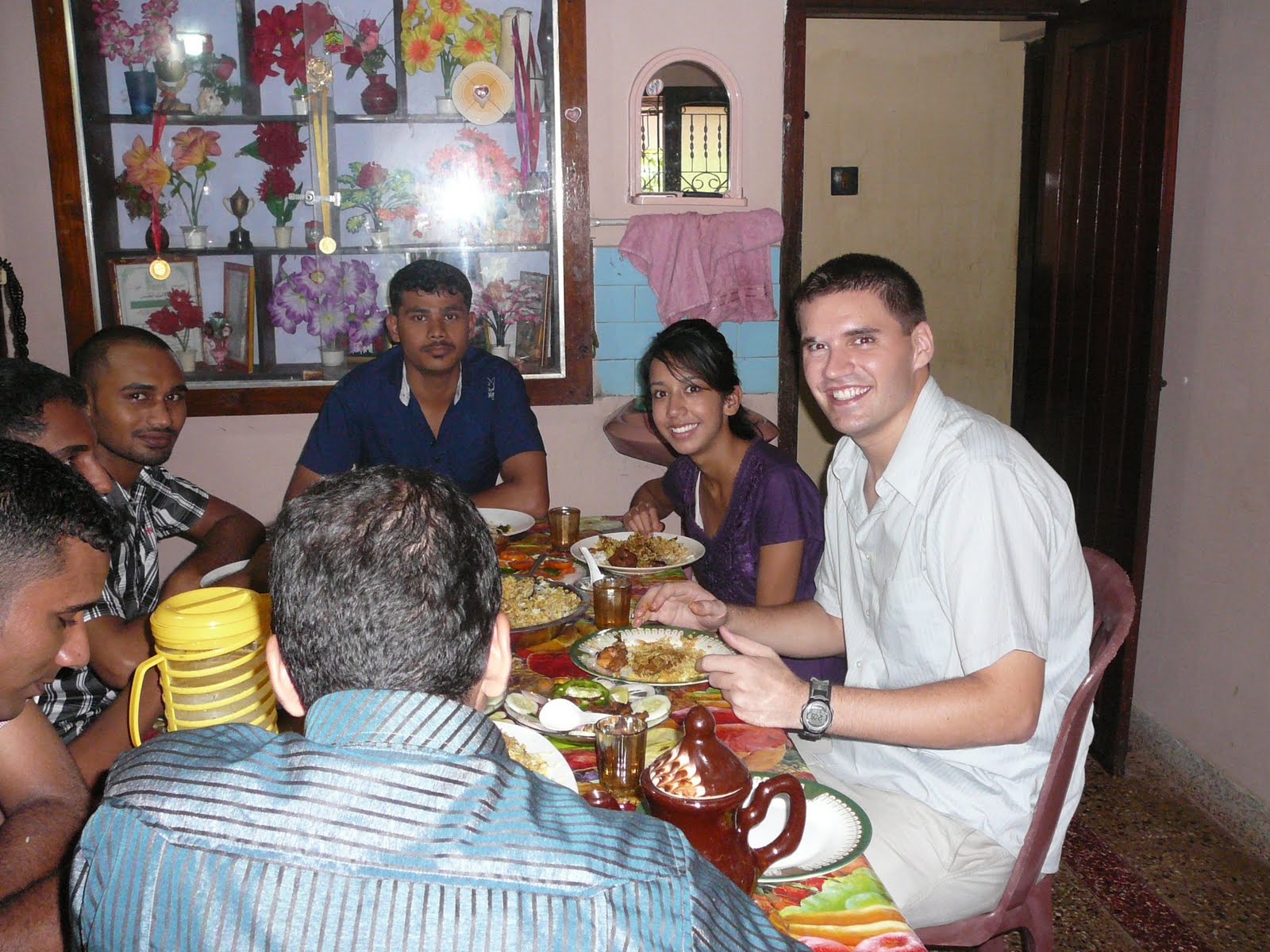
Eid dinner at a friend's house in Tirur. We were served fried chicken, biryani, and payaasaim, which is sweet drink made of sugar, milk, and crushed cashews.
***
“After prayers, then we will go see the slaughter,” Shareef said. “You do want to see the slaughter, right?”
I nodded my head. Of course. It did not seem like an opportunity one passed up too readily.
We were standing on a muddy soccer field on the south side of Tirur on the morning of the Muslim celebration of Eid-al-Adha. Hundreds of Muslims from the area had convened for a special public prayer session. Tarps were laid out in a large square for the devoted to kneel on while keeping their white dishdashas immaculate. A burgundy colored cloth sheet propped up by bamboo poles demarcated the men’s praying area from the women’s.
Shareef—our Tirur-based boss from the American TESOL Institute—had invited us the previous night to come watch the morning prayers and then accompany him to a nearby field where men would ritually slaughter two dozen head of cattle. The offer left a decidedly Biblical impression, which turned out to be right in keeping with the spirit of Eid-al-Adha.
For Muslims, the holiday commemorates the ancient event when Allah asked Ibrahim to sacrifice Ishmael, found in the Qu’ran’s second chapter (or surya). For Christians and Jews, this story appears in the Old Testament and Torah as Abraham stepping forward to heed God’s order to sacrifice Isaac. At the last moment, as Abraham is about to kill his son, God intervenes and praises Abraham’s devotion, then asks him to sacrifice a goat instead.
In recognition of the ancient story, Muslims repeat the ritualized sacrifice of animals on this day. Around Tirur hundreds of cows would be publicly slaughtered in open fields and in the yards of private homes. The meat, then, would be given to family members and friends and donated to the poor.
“The story (of Abraham) is common for us,” Shareef said as we entered the field from a makeshift parking lot at the back. He grasped his young son’s hand as he walked. With us were Ashraf and Shakeela, married friends of Shareef’s. “Ibrahim showed a great will,” Shareef continued, daintily stepping over patches of runny mud. “Impossible to imagine that devotion. But we celebrate his dedication to God and God’s mercy on this day.”
Shakeela took Jenna to the women’s side and Shareef proceeded to introduce me to a string of friends and acquaintances milling about in the growing crowd of worshippers. He seemed to recognize everyone at the event. “Salaam alaikum. Eid Mubarak! Eid Mubarak! Eid Greetings!”
As I began to look around, I spotted several of my students from JM Higher Secondary School. They saw me and waved back excitedly, some walking purposefully up to me and shaking my hand: “Hello, sir, how are you? Eid Mubarak, sir!”
The field was filling up quickly. More tarps and straw mats were brought in to extend the prayer area back towards the parking lot. Dozens of men milled about as they waited for space to be made. All the while, a calming chant of four harmonized voices lifted over the crowd, projected by loudspeakers: “Allahu Akbar! Allahu Akbar!”
The older men at the gathering wore more traditional clothes—flowing white dishdashas and knitted skullcaps, dhotis and collared shirts. The younger men and the boys wore modern dress: tight jeans, brightly patterned button-up shirts, sneakers, their hair gelled and coiffed to perfection. Across the way, I could see the colorful, abstracted milieu of the women’s section—saris, cloth abayas and silky dupattas of every color, creating a variegated tapestry of bobbing heads and waving arms.
A signal was given, and soon all the participants had placed themselves seated on a mat or tarp. The imam (or prayer leader) stood up and faced west towards Mecca. He began: “Allahu Akbar! Allahu Akbar!” He sung the lines in a lilting melody, not unlike a Gregorian chant. The audience repeated the prayer in unison. The crowd did a series of bows and full prostrations on their knees, arms extended out over their heads stretching towards the horizon. Brief interludes of silence punctuated the prayer, filling the field with a reflective calm that is only attainable in moments of worship.
After the prayer, the audience settled into a sitting position and the imam began his sermon, speaking in Malayalam. I noticed younger members of the crowd get up and move towards the back, where they congregated in hushed groups, talking and laughing quietly. As the sermon ground on, more people rose and moved back, greeting each other and roving about the field looking for friends. Small children chased each other and young boys (several of whom I recognized as my students) wandered around aimlessly, glancing surreptitiously over at the women’s section every now and then.
Two things struck me about this event. First, the friendliness of the crowd. I was greeted and salaamed repeatedly throughout the morning. Men I did not know came up to me and shook my hand, asked me where I was from, snapped a photo of me with their cell phones. I quickly learned that “Eid Mubarak” basically means “Happy Eid”, and I began saying it back to those who greeted me with it.
Secondly, any images I had of a monolithic Islamic religion were cleanly removed from my mind. At this one small ceremony in Tirur, I noticed a spectrum of devotion. I saw worshipers who were prayerfully fixated on every move and nuance of the service and hung on every word of the imam during his sermon. I noticed families who skipped in to the service late, with harried looks on their faces (the Muslim version of families who go to church only on Christmas and Easter). I observed worshipers leave the second the opening prayer ended, getting in their cars and on their motorbikes to beat traffic. It was obvious that a wide cross-section of belief was present. Essentially, the same range of religiosity you would find at any church in America.
Shareef and his friends were the types of worshipers who stayed until the very end of the sermon. As the imam closed, and the crowd dispersed, Shareef, Ashraf, Shakeela Jenna and I all congregated back at Ashraf’s car.
“Now, let us see the slaughter,” Shareef said, clapping my back.
***
The men had gathered in a small field, surrounded on three sides by low-slung apartments. On the fourth side lay a small winding road that—a few hundreds yards up—ran past JM Higher Secondary School. On most days, the field is an unremarkable patch of tall grass and bent trees. On Eid-al-Adha, though, it had quite literally turned into a killing field.
Ashraf drove up and let us out and said he would park the car further down the road. Cars, motor bikes and scooters clogged the narrow lane and men stood hesitantly on the edge of the field on the road’s curb, looking out towards the field where more men were huddled around an inert form on the ground. A line of Brahmin cows stood laconically tied to a rope tether by a small tent held up by bamboo poles. A few men under the tent were ecstatically waving their hands, asking us to come into the field.
“There are no women here,” Jenna said, pausing at the grass’s edge. The smell of cow manure permeated the air.
“Come on,” I said. “Just watch out for the cow patties.”
We wound our way through the maze of dung and weeds and finally reached the tent, where the men who had been waving shook our hands vigorously. Then, one man—who had a spot of blood on his white T-shirt—pointed further into the field, where the crowd of men we had seen from the road was standing in a loose circle.
From our new vantage, we could see what the inert form had been: a slaughtered cow, it’s neck severed nearly all the way through, a red coiling mass of muscles and tendons bulging out of the gaping wound. This cow, which lay dead at the center of the circle of gawping men was only the latest sacrifice. A dozen other cow carcasses lay around the field, all with the same slash at the neck, the boils of blood spilling onto the green-brown grass around their heads.
Jenna and I both reserved judgment. No thoughts of humanitarian angst or meat-eaters’ guilt ran through our heads. After all, we love a good steak. And we have talked longingly of hamburgers ever since we got to India. Here, we were presented with about 20 fresh tons of T-bones and Big Macs. We couldn’t complain.
But the plain fact of the matter is: neither one of us had ever seen an animal slaughtered. We had never witnessed the last moments of life and had never watched an animal struggle for its very existence before succumbing to death. In this manner, the scene before was rather discomfiting.
The men given the task of sacrificing took the cows one by one from the tether. They led the next beast to an open spot in the field. The crowd of watchers gingerly followed, small boys and teenagers pushing to get the best view. Three men pushed the cow to the ground so it was lying on its side. Two men tied its legs together. Another man twisted the cow’s head so that the soft underside of its neck was exposed . The whole while the beast struggled, baying and groaning against the combined efforts of the sacrificial team. At last, the man with the knife came in, bent down, and with a vigorous sawing motion cut into the cow’s neck. As the cut was made and blood spurted from the wound, the men in the circle whispered, “Allahu Akbar.” The neck made an astonishing hissing sound as the blood was released. The nearly severed head jerked and twisted and the cow’s tongue reflexively lolled out of its mouth.
I had read stories of the French Revolution, when traitors to the state were beheaded, how their bodies continued to twitch after the guillotine’s blade had come down. I had always remembered that detail both because it was patently gruesome and anatomically fascinating. Now, in the wake of the cow being slaughtered, I watched as its whole bulky frame twitched and shuttered, its legs kicked out spasmodically and the muscles in its face unbelievably continued to flicker with life. The cow, whose throat had been cut, still convulsed out a moo before choking on blood.
I describe all this not to be prurient or sensational. The whole ritual was played off within a context of respect and duty. I learned from an elderly man surveying the sacrifices that the cows had been purchased by teams of buyers, of which each member donated Rs. 2,500. “For each share, the person can take home part of the cow. Many donate the meat to the poor,” he said. “It is God’s will.”
In this world of industrial meat-packing plants and giant corporate cattle farms, what we were witnessing on this field in Tirur must actually be a rather dignified way for cows to go—prayed over as they die, stripped of their meat by hand knives, their meat parceled out in a spirit of charity and communalism. It all struck me as very ancient. I imagined similar rituals happening centuries even millennia ago.
Shareef had come and he was still walking with his young son. “You like?” he asked with a big grin. “It is wonderful, nahn? So much meat. You want some?”
I demurred, but Shareef would have not of it. “Of course, you should have some.” He gestured to new teams of men, who had begun skinning the carcasses and flaying off gigantic shanks of fresh meat that still seemed to pulse with life. One grunted under the strain of an entire leg as he carried it back to the tent.
“You will have beef tonight!” Shareef said proudly. There was certainly plenty to go around, I thought, as I looked over the field of sacrifices.
Tuesday, November 16, 2010
When Elephants Roamed the Streets
I wrote this entry a few weeks ago and never published it. Jenna and I are on holiday for the next three days for the Muslim celebration of Eid-al-Adha, which commemorates Abraham's willingness to sacrifice Ishmael (Isaac to Christians). The holidy coincides with the annual pilgrimage to Mecca.
***
“Kyle, some guys are riding an elephant down the street!” Jenna said breathlessly, running in from our front atrium, which overlooks Thangal’s Road. I was inside reading.
Now, let me say that a comment like this made in America would hardly raise an eyebrow. After all, if someone tells you some guys are riding an elephant down Noland Rd. in Independence you laugh and say, “Yeah, right. And I bet the flying monkeys are following right behind.”
But in India, this comment is cause for excitement because when someone tells you some guys are riding an elephant down the street in India, you know it very well is probably true. After all, Jenna and I pass a meandering herd of Brahmin cattle clip-clopping their way down the street each morning on our way to work. And Jenna and I were nearly mauled by a family of territorial monkeys in Darjeeling. Not at the Darjeeling Zoo, just in the city Darjeeling.
As it turns out, on this night in Tirur, Jenna was right on the money: three guys were, in fact, riding an elephant down the street right in front of our apartment. It was nearly eight o’clock at night. The trio was balanced precariously on top of a large male pachyderm, which looked as if he was on loan from the Periyar Wildlife Refuge in eastern Kerala. He was the size of our kitchen, taller than a basketball goal and had swooping white tusks that could spear a Volvo.
The men sat splay-legged on top with no saddle or reins, just a clinking strand of heavy iron chains wrapped through the elephant’s mouth. Another set of chains clinked around the beast’s four legs, limiting its range of motion to a few feet forward and backward. I imagine these were in place to guard against death and dismemberment if the large fellow got the idea to escape.
The elephant trundled at the back of a noisy procession of men beating drums, waving flaming torches and chanting. A few political banners bobbed above the heads of the marchers, all of whom were men and boys. Every once and a while, the procession was punctuated by the cacophonic blast of a firecracker.
At Jenna’s entreaty, I quickly put on my sandals and ran out of the apartment after the march. Unfortunately, in my haste, I forgot to grab our camera. On the street, a parade atmosphere pervaded. Children jumped excitedly on the curb. A tiny voice yelled, “Elephant!” repeatedly, as if she could not believe it either. The march had slowed a few paces down from our driveway so I caught up with the elephant quickly, sidled up to it within a few feet. It reeked of offal and grass, just like the elephants I have smelled from a distance at the zoo. I paid attention to the darkened street, mistaking piles of asphalt and broken stone for elephant dung. Other young boys and middle-aged men jogged from down the street towards the group, having heard the same rumor that I had about an elephant walking down the street.
Political rallies are common in Tirur, at least they have been since we have gotten here. The municipal elections just occurred less than a week ago and the party that had long been in power summarily lost. The victorious party has been holding victory rallies every since. I recognized the colors—green and yellow—of the winning party, in the banners up ahead of the elephant. I wondered if the elephant was just another campaign tool meant to attract attention. If it was, it was certainly working. Other political rallies we had seen in the previous week had been met with disinterest and annoyance from pedestrians. However, this rally was garnering attention and genuine enthusiasm, most of it centered on the elephant.
Yet, by the looks of the heavy chains and the forlorn fluffing of his big ears, I don’t know if the elephant approved of this message.
As with all campaign gimmicks, after a few moments, I lost interest. The march had slowed to a crawl and the sound of bleating horns and incessant drumming was getting old. I turned back towards our apartment. As I turned a corner, I spotted a 9th standard student from JM Higher Secondary. I had taught him the previous day.
“Hello,” I said, in the labored self-conscious way I greet all my students, sure to enunciate every syllable.
“Hello,” he replied with a smile. “Home?” he gestured along the street.
I nodded. “My flat,” I pointed towards our complex. He nodded and grinned again. He was carrying a bag of groceries.
“Elephant. Down there,” I pointed excitedly, grinning widely. “There is an elephant.”
He looked down, confused at first. “Elephant? Here?” he asked.
I nodded emphatically, sure he would start running as I had earlier. But he simply shrugged, as if it was no big deal. “Okay,” he said. “Goodbye. See you tomorrow.” And he began walking casually down the street, towards the noise of horns and drums.
I guess there are more interesting things to do in Tirur than watch an elephant walk down the street.
Monday, November 15, 2010
Teaching to the Test
After watching students at JM Higher Secondary take the Kerala state mid-year exams for the past two weeks, I have begun to think either Indian students are exceedingly overworked or American students are phenomenally pampered. Or, it may just be the case that a small amount of truth rests in both conclusions.
Either way, I invite both the designers and critics of America’s public school testing regime to come to Kerala during exam season to observe the South Indian definition of ‘standardized test’. A few things will immediately stand out for any American educator used to the No Child Left Behind way.
First, the students in Kerala take a lot of tests. I observed students as young as 13 taking exams for three different sciences—Biology, Chemistry, and Physics; for four different languages—English, Hindi, Arabic, and Malayalam (the local language); not to mention, tests for such standard subjects as Social Studies, Math, and Computer Technology. All these tests were timed, the longest lasting two-and-a-half hours, the shortest just 45 minutes.
Contrast that with my experience in Texas, where in some years in secondary school, students take only two untimed tests—English and Math—for which they get an entire school day to finish. The most students will be tested is in 4th, 8th and 12th grades, when they are required to take English, Math, Social Studies, and Science (and sometimes Writing). In those years, testing is typically finished in one week. Even then, the staff at Hogg Middle School constantly stressed about ways to buttress the students’ stamina and alleviate their tiredness. I cannot imagine if the students had been asked to test for an additional week.
Secondly, the only supplies students were given during testing was the actual test and sheets of paper on which to write their answers. They brought their own pencils and pens, erasers, rulers, protractors, and math compasses. And they used them all. For the math and science tests, many times, I saw students drawing intricate geometric designs, labeling self-drawn circles and pentagons, mapping out entire charts and bar graphs by hand on their answer papers. For the language and social studies tests, students would write paragraphs and (sometimes) entire pages worth of responses to questions that apparently required thoughtful, essay-style answers. (In multiple languages, no less.)
I hardly need to go into detail about how the system in Texas is different. It is summed up in one word: bubbles. Students at Hogg fretted, complained, and sometimes slept their way through tests that required them to answer 50 multiple-choice questions and color in a sheet of bubbles. As far as I could tell, not a single question on any test I saw in Kerala was multiple choice, fill-in-the-blank, or short answer. In addition, during testing week, Hogg provided the students with every single they would need for the test—pencils, erasers, sharpeners, rulers, snacks, bottles of water, pre-packaged lunches. The students simply had to show up—which many of them would do, proudly walking into school mere seconds before the exam started with nothing but their school uniform.
Finally, a difference that may not be as glaringly apparent as a lack of bubbled-in answer sheets: attitude. At JM, over the course of eight straight days of testing, I never saw a student complain, never witnessed a student put their head down, and never noticed anything but commensurate effort. Does this mean every student passed every test with flying colors? Of course not. Students sometimes looked confused or perplexed. They erased and re-erased answers with a vigorous desperation. They pleaded to continue working after testing time had ended, showing their answer sheets that proved they were only halfway through the exam. A few even made fairly naïve attempts at cheating—whispering to classmates and taking comically long glances at their neighbors’ exams. Yet, my point is, the desire to achieve was apparent at all times. Never did it appear as if students were flagging or becoming upset or quitting.
Not every student I had in Texas regarded testing time as a boring, weeklong mini-vacation. But enough did to make it exceedingly stressful for teachers worried about students’ effort and ‘mindset’ on the day of an exam. I remember in my final year at Hogg, encountering one of my students in the afternoon after school on the day of the state Reading test. I asked him how things had gone. I was worried about him because he had shown much apathy and contempt throughout the year. He looked at me and shrugged: “I slept most of the time. Then I filled in the answers at the end.”
Of course, most students at Hogg did not have such jaded views of testing. Most tried their hardest and most wanted to succeed just as much as the students at JM. I guess it just shocked me during the past two weeks the complete lack of such attitudes in Kerala, so accustomed had I become to trying to motivate students and build up their self-confidence and willpower, convince them that these tests were worth their valuable time and effort. In Tirur, even the students Jenna and I have deemed ‘troublemakers’ appeared wholly invested in doing their best on the exams and doing it on tests that frankly asked a lot more of them cognitively then simply filling in a series of bubbles.
There are some disadvantages, of course, to the testing systems I saw in Kerala. What is to say these tests are truly valid when students must spend a large chunk of their testing time hand-drawing charts and diagrams? And how are essay answers reliably scored and enhanced with constructive, timely feedback? And I really have no idea how well prepared the students were by their teachers. What is not to say the students were being asked to perform tasks and functions that they had not been taught? These are questions that bear more scrutiny.
I just know that American students have shown a marked decline in reading and math levels as measured by standardized international tests administered around the world. India is one nation that long ago surpassed the US in such measures. For my two weeks watching exams in Tirur, I saw ample proof why.
Either way, I invite both the designers and critics of America’s public school testing regime to come to Kerala during exam season to observe the South Indian definition of ‘standardized test’. A few things will immediately stand out for any American educator used to the No Child Left Behind way.
First, the students in Kerala take a lot of tests. I observed students as young as 13 taking exams for three different sciences—Biology, Chemistry, and Physics; for four different languages—English, Hindi, Arabic, and Malayalam (the local language); not to mention, tests for such standard subjects as Social Studies, Math, and Computer Technology. All these tests were timed, the longest lasting two-and-a-half hours, the shortest just 45 minutes.
Contrast that with my experience in Texas, where in some years in secondary school, students take only two untimed tests—English and Math—for which they get an entire school day to finish. The most students will be tested is in 4th, 8th and 12th grades, when they are required to take English, Math, Social Studies, and Science (and sometimes Writing). In those years, testing is typically finished in one week. Even then, the staff at Hogg Middle School constantly stressed about ways to buttress the students’ stamina and alleviate their tiredness. I cannot imagine if the students had been asked to test for an additional week.
Secondly, the only supplies students were given during testing was the actual test and sheets of paper on which to write their answers. They brought their own pencils and pens, erasers, rulers, protractors, and math compasses. And they used them all. For the math and science tests, many times, I saw students drawing intricate geometric designs, labeling self-drawn circles and pentagons, mapping out entire charts and bar graphs by hand on their answer papers. For the language and social studies tests, students would write paragraphs and (sometimes) entire pages worth of responses to questions that apparently required thoughtful, essay-style answers. (In multiple languages, no less.)
I hardly need to go into detail about how the system in Texas is different. It is summed up in one word: bubbles. Students at Hogg fretted, complained, and sometimes slept their way through tests that required them to answer 50 multiple-choice questions and color in a sheet of bubbles. As far as I could tell, not a single question on any test I saw in Kerala was multiple choice, fill-in-the-blank, or short answer. In addition, during testing week, Hogg provided the students with every single they would need for the test—pencils, erasers, sharpeners, rulers, snacks, bottles of water, pre-packaged lunches. The students simply had to show up—which many of them would do, proudly walking into school mere seconds before the exam started with nothing but their school uniform.
Finally, a difference that may not be as glaringly apparent as a lack of bubbled-in answer sheets: attitude. At JM, over the course of eight straight days of testing, I never saw a student complain, never witnessed a student put their head down, and never noticed anything but commensurate effort. Does this mean every student passed every test with flying colors? Of course not. Students sometimes looked confused or perplexed. They erased and re-erased answers with a vigorous desperation. They pleaded to continue working after testing time had ended, showing their answer sheets that proved they were only halfway through the exam. A few even made fairly naïve attempts at cheating—whispering to classmates and taking comically long glances at their neighbors’ exams. Yet, my point is, the desire to achieve was apparent at all times. Never did it appear as if students were flagging or becoming upset or quitting.
Not every student I had in Texas regarded testing time as a boring, weeklong mini-vacation. But enough did to make it exceedingly stressful for teachers worried about students’ effort and ‘mindset’ on the day of an exam. I remember in my final year at Hogg, encountering one of my students in the afternoon after school on the day of the state Reading test. I asked him how things had gone. I was worried about him because he had shown much apathy and contempt throughout the year. He looked at me and shrugged: “I slept most of the time. Then I filled in the answers at the end.”
Of course, most students at Hogg did not have such jaded views of testing. Most tried their hardest and most wanted to succeed just as much as the students at JM. I guess it just shocked me during the past two weeks the complete lack of such attitudes in Kerala, so accustomed had I become to trying to motivate students and build up their self-confidence and willpower, convince them that these tests were worth their valuable time and effort. In Tirur, even the students Jenna and I have deemed ‘troublemakers’ appeared wholly invested in doing their best on the exams and doing it on tests that frankly asked a lot more of them cognitively then simply filling in a series of bubbles.
There are some disadvantages, of course, to the testing systems I saw in Kerala. What is to say these tests are truly valid when students must spend a large chunk of their testing time hand-drawing charts and diagrams? And how are essay answers reliably scored and enhanced with constructive, timely feedback? And I really have no idea how well prepared the students were by their teachers. What is not to say the students were being asked to perform tasks and functions that they had not been taught? These are questions that bear more scrutiny.
I just know that American students have shown a marked decline in reading and math levels as measured by standardized international tests administered around the world. India is one nation that long ago surpassed the US in such measures. For my two weeks watching exams in Tirur, I saw ample proof why.
Subscribe to:
Posts (Atom)