Welcome to our blog

Read up on how we are doing in India. Follow us from Kolkata to Kerala...and now back again.

Monday, February 14, 2011

Love Is in the Air

It is not a skirt, it is a dhoti. And it was my Valentine's Day gift from Jenna.


My Valentine's Day 'surprise' for Jenna: cake and a card.


I figured since Valentine’s Day is a holiday most Indians do not celebrate, I would get a pass this year. My wife thought differently.

Jenna bounded from the bedroom this morning with a broad smile on her face to greet me as I grumpily made coffee in the kitchen. “Happy Valentine’s Day, sweetie! I have a surprise for you,” she said lovingly as she reached up to kiss my scratchy, unshaven cheek.

I froze. Oops, I thought.

It turns out Jenna had decidedly not forgotten about Valentine’s Day and had bought me an authentic Kerala dhoti, a traditional sarong-type loincloth worn by men everywhere around here. I had been saying for weeks how I wanted one for a souvenir, and on this morning, I was pleased to be holding one in my hand. Made of thick cotton with a light blue stripe rounding the edges, it felt comfortably heavy in my hands.

I sheepishly looked up at Jenna. “I’m sorry. I didn’t get you anything. I thought we weren’t having Valentine’s Day because, you know…” I shrugged my shoulders pathetically.

“It’s okay. I know. You being here is enough of a present,” she said sweetly, and kissed me again. How do women know the exact thing to say to make you feel like an even bigger jerk than you already feel?


In a small measure of recompense, I stole away from JM this morning while I was not teaching and dashed back to the bakery near our apartment. I bought some pieces of cake that had pink icing and were topped with Maraschino cherries, I hustled back to the apartment, stole a card from a pile of blank ones our roommate Jaime keeps, and whipped up a Valentine’s Day surprise for Jenna.

The improvisation worked. When we got home today, Jenna smiled brightly and said, “You remembered after all.” And I shrugged, as if it was part of plan the entire time.

As for Indians, I get the impression that Valentine’s Day—like Facebook and pop music—is seen by the older, more tradition-bound generations as an unwanted Western incursion. A particularly curmudgeonly editorial in The Sunday Express begged in its opening paragraph, “Somebody please retire this Valentine’s Day. All these pink balloons, red musical cards, and messages on FM radio are irking this [writer].” Though I cannot say I disagree with the editorial’s overall message that ‘true’ love is hard work that should consume every day of a relationship and not just a once-a-year holiday.

However, there was nothing guarded about our fellow teachers’ reactions to the candy conversation hearts we brought to work. Jenna’s mom had enough foresight to mail a bag of the traditional Valentine’s Day treats in mid-January. The staff openly loved them. They grabbed handfuls and twittered at the tiny messages, showing them to each other, and stifling giggles.

Santosh, ever the aspiring Casanova, went around showing one particular heart to all the female teachers. “Kiss me! Kiss me! Kiss me!” he said, quoting from the heart he held in his fingers. The women looked at him askance, and I called out to him: “Be careful!”

At least for one day, love was (sort of) in the air at JM.

Friday, February 11, 2011

Faces of Payannangadi

The youth of Payannangadi: some boys who live in the houses behind our flat. The boy in the navy blue shirt in the middle and the one in the neon blue shirt in the left corner attend JM.


With just a little more than a week left in Tirur, Jenna and I are starting to take stock of our surroundings here. For the past four months we have lived in a district of Tirur called Payannangadi. We have gotten to know our neighbors pretty well despite the language barrier, and we have come to realize we will miss them once we leave. Followers of this blog deserve a closer glimpse at the faces we have come to know, trust, and depend upon in our time in Kerala.


The Watchman: Mohammed Ali (named for the prophet, not the boxer) is a retired businessman who spends his days hovering around Payannangadi, keeping a lookout for anything out of the ordinary. A good man to have in your corner.


Party boys: Anshawd (on the left) helps his father with an electronic repair business; Shafik (in the middle) helps his brother Anwar (pictured later) run the corner store, and Rafi operates a clothing store in Tirur's central market.


Chai-wallah: Mammooty runs a small tea stall right outside our flat. He has been doing it for more than 30 years.


Aneef owns Zain Bakery, a new establishment that serves delicious fruit shakes and shawarma (diced chiken in pita bread.)


Anwar runs the corner store where we buy most of our groceries, including milk and biscuits everyday for afternoon tea.


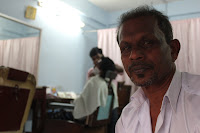
The barber Hamza, who has cut my hair a couple of times in Tirur. He speaks very little English but does a wonderful job going off old pictures of my with shorter hair.


The Internet guy: probably our best friend in Tirur, Nahas the manager of Netway Computers, the Internet cafe Jenna and I frequent daily.


Tuesday, February 8, 2011

Super Bowl?

America's biggest sporting spectacle reduced to ungrammatical coverage on page 15 of the newspaper in India.


Minnesota Vikings fans will be glad to know that nary a soul in Kerala either understands or cares that the Green Bay Packers just won the Super Bowl. Rather India has its sporting eyes set on the upcoming ICC Cricket World Cup, which is being hosted by India and Sri Lanka this year. The mega-event is set to begin in just under two weeks and will be played over the course of nearly 50 days at several sites around the Subcontinent. Teams representing 14 countries--all of which except the Netherlands are former colonial holdings of the British Empire--are chasing the cup. I imagine results from the ICC World Cup will warrant as much coverage in American newspapers as the Super Bowl got in India.


***
Meanwhile, Tuesday was my final day teaching at JM's 'upper campus', the school for high school students on the verge of graduation. Though Jenna and I do not leave Tirur for almost two more weeks, the 'upper campus' students begin their final exams next week. Therefore, my services will not be needed, and I say 'goodbye' early.


Since I only spent two half-days a week at the 'upper campus', I did not anticipate feeling as nostalgic as I did. I bought the staff a small cake in celebration, hopefully letting them know how much I appreciated their hospitiable attitudes during my stay. The staff at the 'upper campus' is an extremly cohesive bunch, bright and energetic. The students proved a challenge, but I feel that I am leaving at just the time when I was beginning to witness noticeable progress in class. For that, a part of me wishes I could stick around to see how these kids grow in the future.


Me with Vinod and Santhosh, my two best friends at the upper campus.


The celebratory cake, inscribed with the message, "Thanks, J.M.H.S.S."


Upper campus staff digging in.

Monday, February 7, 2011

The Arrangement


Santhosh. Who could turn down this guy's proposal?


Ladies, Tirur’s Most Eligible Bachelor is off the market.

Our friend Santhosh, a Biology teacher at JM Higher Secondary, announced today that his wedding has been ‘arranged.’. That is the vernacular in Tirur. It’s not: “Oh, I’m getting married!” It is always, “My marriage function is arranged.”

The lucky girl is a 26-year old Physics teacher from Calicut named Ambili, an acquaintance of Santhosh’s uncle’s sister-in-law.

“My uncle call me and say, ‘I have a girl. You need to meet’. And we met a week ago,” Santhosh told me on our free period Monday. “I went with my best friend to Calicut. We went to her house. I walk in and see this girl. Everyone is there watching. I come up to her and ask her name, what she do, what she like. She asks me the same. We hug and that is our arrangement.”

“Did you kiss each other?” I whispered, feeling like a gossip.

Santhosh’s eyes widened in horror, “No! No, no, no! Of course not! That is not until marriage function.”

He informed me the wedding was set for early May. My shoulders slumped. I told Santhosh Jenna and I planned to be back in the US by then.

“You come back, no problem. You must. You are my intimate.” Intimate is Santhosh’s word for BFF.

“But Santhosh,” I said reluctantly, “that costs a lot of money.”

“You are American. Money no problem.”

I told him exactly how much money it would be for both Jenna and I to book round-trip plane tickets from America to India and then translated that figure into Indian rupees, an amount, incidentally, that is more than what Santhosh makes in a year at JM.

“Oh,” he said, then paused. “But you can stay at my place. You won’t have to pay for food and accommodation. You must come.”

I shrugged my shoulders, “We will send you a gift.”

Santhosh’s eyes brightened, his sharp eyebrows lifted. “Yes. Yes, that would be nice,” he said. “American commodities are very good. I would like that.”

I think we had reached a compromise.

Saturday, February 5, 2011

Give 'em the 'Stick'

Classroom management, India-style.


As far as I can tell, many Indian parents come from the ‘spare the rod, spoil the child’ school of discipline. A right spanking is a common sight on Indian streets, as are quick slaps to the back of the head, discreetly employed shoves to the shoulder, or the firm grasp on the upper arm.

Teachers, likewise, have few qualms with using ‘the stick’ to enforce classroom rules. Most staff members at JM carry around their own personal ‘stick’—a thin bamboo switch the circumference of a pinky finger. One teacher has even smartly labeled her stick with her name, so that no other teacher will make off with it.

I first saw the ‘stick’ method of discipline at JM’s upper campus a few weeks into our stay in Tirur. A line of tardy students waited patiently outside the teacher’s lounge until a staff member came along and demanded they hold out their palms. Each did and, in turn, received a swift whack on their hand. Then, with slumping shoulders, they walked to class.


I can’t say I approved that first time or the many subsequent times I saw a teacher take a stick to a student’s palm or an upper arm or even a thigh. (And, let’s be clear: when I say ‘students’, I am talking exclusively about boys. I have yet to see a girl get the stick, though I do not know if it is simply because their behavior is better or because there is a school policy against physically disciplining young women.) I still find it a bit unnerving to see a teacher (again: usually male) whapping away at a cringing adolescent for some unknown offense that the student is pleading against as the sharp blows reign down on his hand or arm. As a teacher in America, I am used to the notion of bearing a misbehaving student with patience and discourse, employing a long list of psychological carrots and sticks, and, at the most extreme, sending the student away to the office so someone with more apparent authority can suffer the problem.

The idea of using a bamboo rod as a form of immediate, physical intimidation is a taboo notion for many American educators, and, I think, rightly so. Corporal punishment was abandoned long ago in most realms of public education. (Though I would be lying if I said I never would have appreciated the handiness of a bamboo switch while teaching in the US.)

Anecdotal evidence at JM tells me the implementation of the ‘stick’ is not a very effective form of punishment. I see the same students getting whipped time and time again, meaning their prior whippings are not a deterrent. And I find the staff, in general, conducts the ‘stick’ method inconsistently. Some teachers resort to it almost daily. Other teachers appear loath to even have one in their hand. Still others joke with it, pantomiming the act of whipping a student and then laughing about it.

With all that said, I cannot report that I have stayed above the fray. Class VIII-D drove me to it.

Class VIII-D is a generally sweet but abnormally rambunctious group of nearly 40 students. The boys are brimming with energy, pinching each other, slapping each other’s backs, yelling across the room, chasing each other, pushing each other out of their benches, and ripping each other’s papers to shreds. The girls—as demure and shy as they are—are entertained by the boys’ antics, thereby encouraging them with their giggles and laughter.

I have found my American methods of discipline wholly ineffective for Class VIII-D. A palm in the air will stay raised for five whole minutes with no abatement in the noise. A few quick slaps to the teacher’s desk will raise a few eyebrows, nothing more. Lecturing in English, of course, does no good with kids who speak barely a word of it. (Lecturing did not work with American kids, either.) A point system garnered interest for a time, but then they grew bored with it.

One day two weeks ago, I approached Bindu—Class VIII-D’s home room teacher.

“This class…very wild. Loud. Playful,” I said, making a clownish face and waving my hands in the air to convey my point.

Bindu looked at me with a smirk. “Yes. Bad class. Bad class.”

“What can I do?” I asked.

“The stick. You need stick,” she said, pulling hers out of a fold in her teacher’s jacket like King Arthur brandishing Excalibur. She tried to hand it to me. I backed away, my palms up as if she were offering me a live cobra.

“No, no, no,” I said. “I can’t use that. The stick? No. Not for me.”

“Not use it,” she said, smiling. “Just show.” She held the stick up like it was a trophy, some primordial token won from another prehistoric tribe. “Show it to them. They are scared of it.”

I felt showing the stick with no intent of using it was not much better than actually whipping kids. Bringing it into the classroom, I felt, set a precedent for my teaching with which I was uncomfortable. Simply having it there in class meant I might use it or be tempted to use it. The students would draw one of two conclusions about me, neither of which I liked: a) I would now possibly whip them, or b) I was just a stick poseur who was too squeamish to actually carry through my threatened intent.

Bindu solved my moral conundrum by shoving the stick into my hand. “Just take it. One time. See if it works. But I need it for sixth period.”

Reluctantly, I took the stick to Class VIII-D. With an odd mixture of satisfaction and dread, I realized the sight of the stick in my hand had an immediate effect. The class, usually so rowdy at the beginning, became quiet in a remarkably short time. The boys straightened their backs and stared at the front of the class where I was standing. The silence of the room made me feel eerily victorious.

During the lesson, I kept the stick in my left hand the entire time. I used it as a pointer at the board. I used it to call out students. A few times, I slapped it against the teacher’s desk with a sharp thwack, to get the class’s attention. In short, Bindu’s advice had been correct. The stick—at least as an agent of intimidation—worked. I did not yell. I did not lecture. I did not feel frustrated. Instead, I felt effective and vindicated. The only tradeoff was that a part of me also felt a little like Bull Connor.

For the next couple of weeks, I borrowed Bindu’s stick before going to Class VIII-D. The mesmeric power of the stick seemed to hold. That class went from being one of my worst headaches to one of the highlights of my day. With the looming presence of the stick, the students’ sweetness overcame their penchant for rowdiness. Their intrinsic affability did not spill over into mayhem.

Yet, I wondered: how long would this work? The first time a student really challenged me or behaved in a way that clearly warranted a whipping, the class would see it was all a hollow threat. The stick, I feared, would then just become another casualty like my other previously tried and discarded methods of discipline.

I must say this is an ongoing experiment. I have continued to bring the stick to Class VIII-D up to the current week and have still had no cause to really ‘use’ it. With only two weeks to go at JM, I foresee that I might possibly get away with this ruse without ever being pushed to a crucial decision point. I just hope the students of Class VIII-D don’t get wise.

Die With Your Boots On

Students worked on superlatives this past week. They made graphic organizers describing which school subjects were 'easy', 'easier', and 'easiest' for them.


Some girls hard at work.


Boys showing off their handiwork.


With two weeks to go in our time at JM, I have become more reflective. I think often of the things I will miss about the school and this experience (as well as the things I will not miss, such as the potato-tomato-onion-okra masala we concoct every day for lunch).

I feel it is a guarantee, for instance, that conversations like the one I had earlier this week with a Class X boy will not occur very much once I am back in the US.

Student: Where are you from in America?

Me: Texas. (I have found it easiest to say ‘Texas’ when students ask this question because a) they are more likely to have heard of Texas and b) they have trouble pronouncing ‘Missouri’; it comes out like “Misss-er-y”.)

Student: Ah, Texas! Is it close to New York City?

Me: No.

Student: Is it close to San Francisco?

Me: No.

At this point, I grabbed a piece of scratch paper from the student’s notebook and drew a blob shaped roughly like the United States. I put dots on each coast, marking New York and San Francisco. Then, I put a dot in the triangular protuberance of the US’s underside which is Texas.

Me: Here. Here is Texas. You see? The US is very big.

Student: How far? Texas from New York?

Me: I don’t know. More than 1,000 miles.

Student: One thousand miles? Whoa! Big!

Me: Yeah, big. Do you know Texas?

Student: (shaking head) No. Not really.

Me: Texas…ummm…oil? George W. Bush? Cowboys?

Student: Cowboys? I love cowboys! Do you have a horse in America?

Me: Uhhh….no. No horses for me. Some people do.

Student: Can you ride a horse?

Me: Not really. I mean, I rode one once.

Student: How do you get around?

Me: Uhhh…most people in Texas drive…a car.

Student: Yes. Yes. Cars. And horses?

Me: Yes, some people ride horses.

In India, an American can pass himself off as a cowboy if he is from Texas. Or a movie star if she is from California. Or a rap imresario if they happen to hail from New York City. Such are the simplified but oddly charming stereotypes the students at JM have about Americans, culled from the random bits of pirated pop culture they have received from TV and the Internet.

A word of advice, then: If you ever travel to India and are from an unknown backwater like Missouri, well, just tell an Indian you’re from Texas.

Wednesday, February 2, 2011

Get Up, Stand Up

A socially minded group of JM students marching thorugh Tirur Wednesday, voicing their anti-drug sentiments.


Members of the India Scouts marching through Tirur's main square.


Students chanted slogans in Malayalam against drugs, tobacco, and alcohol. Roughly translated: "Leave drugs alone! Say no to drugs!"


This boy seemed very happy to be in the march. Maybe he was just glad he was missing school.


Students brandished homemade signs. This was one of the few in English.


The day was hot but the students seemed unbowed by the weather.


I knew something was up during first period Wednesday when students began massing in JM’s courtyard carrying placards, banners, and picket signs.

Most of the signs were in Malayalam but a few had accompanying pictures—a skull and crossbones, a brown bottle crossed through with a red ‘X’, a skeleton smoking a cigarette. A few teachers ambled down to the courtyard. I asked one of them what was going on.

“Rally against drugs. No smoking. No alcohol,” she said,throwing her gaze over the dozens of students who were gathering into a neatly ordered line. Most of the students were wearing the blue and purple uniform of the Indian Scouts, the youth service organization modeled off the American Boy Scouts. The scout leader—who doubled as one of the gym teachers—was barking instructions through the school’s PA. About 100 students dutifully fell into rank, hoisting their signs over their heads.

Another teacher came over to Jenna and me. “You should participate. Rally against drugs and alcohol. No drugs. No smoking. No alchol.”

In my mind, I told myself: Well, I don’t know if I should. I mean, I’m for alcohol. But the expectant look in the teacher’s eyes made it clear what I should say.

“Sure. We’ll come.”

The march started a few minutes later. In the tradition of their forebears Gandhi and Nehru, the JM students were using a rally to make a social point. As they exited the gates, the students began chanting slogans in Malayalam. Throughout the line—which snaked back nearly 50 yards—handpicked students led the chorus, shouting rhythmic lines like drill sergeants. The other students around these ‘cheer leaders’ then echoed the lines in cadence.

“What are you saying?” I asked one of the ‘cheer leaders’ as she sucked in a big gulp of air to shout anew.

“Leave tobacco alone! Smoking causes cancer!”

The line moved at a military clip through Tirur’s back roads and emerged soon on to the city’s main thoroughfare, where the students had to contend with screeching buses, honking lorries, and puttering auto rickshaws. As they walked, pedestrians stopped to listen to the students shouting. Workers came out of their offices to gape and stare, possibly more interested in the white man flitting along the flanks of the rally snapping pictures like a frenzied wedding photographer.

A few students exited the line to pass out pamphlets to passers-by. One student approached a group of men huddled around a motorbike. He quickly shoved the pamphlets in each of their hands and walked on. The men quizzically stared down at the rectangular piece of paper, printed in Malayalam with a picture of a skull smoking a sick-looking cigarette on the masthead.

The line reached Tirur’s main square and then did an about face and proceeded back down the main road, then entered a side street that took us back to the school. By now, the ‘cheer leaders’ were getting hoarse and a few new ones had stepped in to relieve them. However, one girl—Khadeeja, one of my Class VIII girls—kept at it emphatically. Her voice broke and cracked but she sucked in air in gasping heaves and tensed her diaphragm for each new call. Her shoulders pitched back and her spine straightened and she looked towards the sky with each recitation, summoning all the spirits of India's political past into her full-throated yelps.

Here, I thought, was India’s next Indira Gandhi.

The rally returned to school an hour after it had started. The late morning sun beat down on the dirt courtyard relentlessly. A group of teachers had prepared lemon water as refreshment for the students. After a final shout and some half-hearted clapping, the students discarded discipline and sprinted towards the lemon water stand. They gulped down cups of the hazy stuff as eagerly as they had chanted their anti-drug slogans.

As I reached a spot of shade, I thought: I could use a beer right about now. But that sentiment, I thought, was better left unsaid.